Showing posts with label #randomacts. Show all posts
Friday, 27 May 2016
Weird Town
One
Sandyway Beach was a little town with no more ambition than the frogs which sang it to sleep at night. It hadn’t really changed that much in the two hundred years it had been in existence, but it was still a nice little place to be born, live ,and die in.
Visitors were few and far between given that it was so far off the beaten track; the ones who did turn up tended to be lost or pretended they were when they found they’d driven all that way just to turn up in that little town.
But if you could see the beauty in the place and not ask too much out of life then it was a perfect place to waste away your days.
Wars had been declared and settled, rulers had come and gone, storms had kicked up a fuss and died down again, and not of those things ever touched Sandyway Beach.
Perhaps the universe was saving up all the town’s triumphs and disasters for one throw of the dice and perhaps that throw came in the shape of Clive Otterman.
Clive had once been a strong, fit man who could take on anything and come good, but little by little, bit by bit, life kicked the crap out of him until he held up his heart in surrender and decided to see out his days just sitting by the sea. He felt that life wouldn’t come looking for him under these circumstances; it would pass over him like the angels in the Bible and smite some other sucker.
I guess Clive had always underestimated life - in the way that we all do - because fate doesn’t always attack in big slashes and stabs - sometimes it kills by a thousand cuts and fate wasn’t quite done with Clive yet.
He’d lived long enough to know that life sometimes worked in mysterious way, truly mysterious ways – not Biblical, just those little surprises which sometimes happened at the right time to the right people. That’s what occurred with Tommy Speak, who was the man who lived on the beach and whom life had decided was ready for a little miracle.
If one word was used to describe Tommy it was ‘ordinary’ – in the way that all animals clinging to a rock circling the Sun are ordinary. His school report called him a normal kid - nothing outstanding. His Geography teacher had written ‘ordinary’ and left it at that. Except what is ordinary today could have been considered exceptional many years before. If an ordinary man had stood in the middle of the American Civil War with a camera/phone he would have been considered anything but ordinary. But look what you’ve made me do - I’m well off the story. So just believe me when I tell you that Tommy was the most ordinary person you could ever meet.
Then Tommy met Clive and the rest, as they say, is one huge, confusing mess. I’m not telling you here and now that Clive and Tommy were somehow called on by Heaven to do what they did, I’m just trying to say that from where I was standing it very much looked that way.
Two
Tommy never really asked for normal in his life, it was just the way he was put together and I never really knew if Tommy was just plain lucky or if the universe liked him so much that it gave him a helping hand from time to time.
One night, just before he headed back to the beach, Tommy lifted what he thought was his jacket - but in fact it turned out to be the jacket of one Jeremiah Andrews. I think that the fact the label inside said ‘Property of Jeremiah Andrews’ would have been a giveaway.
That was the evening of the Grand Night Dance. Everyone in town had been at the hall for a jig to thank the Founding Fathers for putting Sandyway Beach exactly where it should be – in the perfect location. Needless to say, Tommy had been drinking Archie’s famous Crab Beach Brew and this left him with the feeling that he could take on the world.
There had been stories passed around town for years about the kind of business that Jeremiah was operating; it covered everything from diamond smuggling to selling donkey meat to the Mexicans and everything in between. To be truthful, those were actually some of the better Jeremiah stories; as the others would have made your hair stand on end – assuming that you had hair,that is.
Tommy swayed and swaggered his way down the cliff path towards the beach, something he had accomplished in many conditions (sometimes it was him, sometimes it was the weather, sometimes it was both). He could do it with his eyes closed and he normally did, but this night he had a strange feeling that he was being watched. I think most folks have got that ability to know when pair of eyes are drilling into the back of their heads.
Suddenly right in front of him, like an apparition, was Everard Smithton.
“Howdee, Tomaso,” as that was the way Everard liked to talk.
“You almost made my hair turn white, Everard,” screamed Tommy who didn’t have any hair.
“Sorry Tomaso but I hate walking back this way alone, especially with that thing on the loose,” said Everard in an accent that was hard to pinpoint (and I’m talking about a continent, never mind narrowing it down to a country).
“What thing?” Asked Tommy, who actually wasn’t really caring.
“I don’t suppose you’ve got a smoke?” Asked Everard.
Now here’s the funny thing, Tommy didn’t smoke but he immediately reached into the top pocket of Jeremiah’s jacket and there were cigarettes and a lighter.
“Well I’ll be....” said Tommy and handed the stuff over to Everard.
“Much obliged,” said Everard as he lit his cigarette.
The two of them were just jumping from the last rock on the sandy beach when the thing that had gotten loose moved towards them.
“What are those two eyes?” Asked Everard, nervously
“Well, my guess is that they’re two eyes,” said Tommy sarcastically (Crab Brew always made him sarcastic).
Then the moonlight caught the animal full on. It was a leopard which had escaped from Fanny’s Victorian Circus which was exhibiting at Seapoint, two towns over. The leopard was stealthy crawling towards them, the way that cats do just before they go in for the kill.
As the leopard started to charge, Tommy went into the right pocket of Jeremiah’s jacket and there was a pistol which he pulled out and shot at the leopard. Tommy missed but the leopard wasn’t hanging around to try again.
“Well I’ll be..” said Tommy.
When they got to Everard’s caravan, they said goodnight and Tommy and his pistol headed for his home on the beach.
On the other side of town, Jeremiah Andrews was just getting out of his truck when a large leopard jumped him. He went into his right pocket to get his pistol and the last thing that went through his mind was: why had he just pulled out a half-eaten sandwich (one that Tommy had left in his jacket for the walk home). By the time Jeremiah got to hospital he was stone cold dead.
As Tommy entered his boat-on-the-beach which he called home, he put his hand in his left pocket thinking the key would be there and in fact found several thousand dollars all tied up with string.
“We’ll I’ll be...” said Tommy, realising this had been one of his better days.
Clive Otterman was not a shy man, nor a man who had been known to be the crazy one in a group. He was just a guy who, it could be said - had lived, and then one day when he was long dead someone would say, 'I wonders what ever happened to that Clive Letterman?' then the guy who asked the question would sip his drink and forget why he asked.
Now to be forgotten ain't a bad thing, it ain't a bad thing at all, but each of us would like to think that maybe just once in a while someone would have a thought about you and perhaps smile or even shed a tear that you were long gone.
There was a box under Clive Otterman's bed where he kept his quiet desperation. It wasn't something that he took out in public to be stared and pointed and poked at, nope, Clive's desperation was kept well buried and he found that bringing it out in the middle of the night was the best solution.
Each of us lives a kind of desperate life, unless you're real stupid and you don't question a single thing (there are folks who say that not questioning is the happiest way to live, but I would have to question that - yeh, that was me being ironic). What I'm trying to say about Clive was that he could get a little addicted to feeling desperate and when he wasn't feeling desperate, he would start to worry about not having something to worry him - wow, when you start down the irony path, it gets hard to put the brakes on.
Desperation fuelled him, he needed to worry to work, or move, or do things which meant that when he was happy, he was the laziest sonofabitch that ever sat on his bee-hind.
I guess what I 'm really trying to tell you, is that Clive was born with his collar turned up, his head down and was just spending time waiting on his death without hurting anyone else or himself. You'd think that life would say that was a reason to leave the poor sucker alone and let him get on with it - but you'd be wrong. Life had put a tick next to his name the way the Revenue people do and that could only mean one thing - trouble.
The night that Clive and Tommy came together in the universe, I guess the planets were in some sort of weird alignment but come together they did. Clive had been down on the beach filling his lungs with good sea air before he planned to go too bed when he heard a gunshot and a man shouting 'We'll I'll be...' in a manner that suggested that the man’s nose was bleeding.
Clive ran to the little boat house on the beach expecting to find a dead lover and someone with a revolver standing over the body. Instead he found Tommy who had just shot the tip of his nose off with his careless use of a firearm.
"We'll I'll be, if tat ain't the weirdest ting...," Tommy was talking through his bleeding nose and it made him sound comical.
"I was so sure there weren't anymore bullets in the ting..."
"Seems you were wrong," said Clive forgetting about his quiet desperation for a few minutes.
"Do you see the end of my nose anywhere?" Tommy asked.
"Well there's a question I didn't think I was gonna be asked when I got out ma bed this morning," said Clive who looked down and found the end of Tommy's nose.
"Is this it?" Said Clive proudly holding the nose tip aloft.
"Dat's an olive, I tink," Said Tommy who wasn't about to have an olive stitched on to the end of his nose.
"Then I guess you blew the end of your nose to the four corners of this room."
"Are you saying ma nose has vaporized?" Asked Tommy.
"I guess I am, by the way my name is Clive, Clive Otterman and you are?"
"In a lot of pain," said Tommy in a sort of smarty pants way.
"I'm going to take you to the hos-pee-tal right now and then we are going to become good friends, I can feel it," Said Clive in a genuine way.
"You would do dat for me, take me to the hop-i-tal?" Said Tommy with tears in his eyes.
And so that was the night that Clive and Tommy became the best of buds, although it wasn't going to be an easy friendship nor a particularly uneventful one but then Angels and their friendships never are.
bobby stevenson 2016
Saturday, 14 May 2016
Thing and His Friend
Thing had never known a time like it, at least not since he had been on his own. The Spring had slipped into Summer and now the leaves were falling all around the front of the cave. Some of the folks from the town had stopped by on their way to the top of the mountain, some stayed for just a few minutes, some for a several hours, talking about this and that and smoking pipes and stuff. Some folks just hurried by with a ‘howdee’ on their way through.
So he really wasn’t alone
and when his mother returned life would go back to the good times. And yet this
was the second winter coming that Things was without her and he couldn’t stop
hoping she’d be back.
It was on Sunday in early
December that one of the walkers mentioned to Thing that there was another like
Thing in town. Perhaps his mother was returning just in time for Christmas?
He’d have to get the cave real sharp, ‘cause his mother always believed in
cleaning and keeping things straight. “There’s a place for everything,” she
would tell him.
He quickly cleaned and
polished until there wasn’t a speck of dust to be seen. He knew his mother
would approve and so he felt safe enough to go down the mountain into town and
make sure it was she.
Just beyond the Library was
a crowd of people, all standing in the way they used to gather around Thing;
back in the days when they were scared of him, that is. But times had changed
and people just let him go about his business. So maybe they were welcoming his
mother, Thing did something he didn’t usually do, he broke into a run. He could
see her head and her arms – people must be welcoming her home.
But it wasn’t his mother,
sure it was another like him, but it wasn’t his mother. This was one of his own
kind who was being welcomed into town, mainly due to all the hard work and
kindness that Thing had shown to the town’s folk.
Maybe this one knew where
his mother was - maybe this one had met her on the way here. But the one who
looked like Thing didn’t know anything about his mother. Thing just turned away
for a spell and sighed and then spun around, smiled and welcomed his new friend
into the town.
Thing said there was always
a warm corner in his cave for a friend, at least until his family got back. But
his new friend said he felt right at home in town and was probably going to
stay there.
Sure enough one of the
farmers took the other Thing in and let him stay in his barn. Thing was
confused, ‘cause surely Things should stick together, since they both knew how
the other thought about people and life.
This got Thing down and he
went to the back of the cave to sit and talk to his mother, hoping wherever she
was, that she could hear him. He said that life had been good for a while but
he would have liked to be friends with the one who looked like Thing.
Suddenly a little wind blew
in the cave and there was the one who looked like Thing standing at the
entrance.
His friend could see that
something was bothering Thing and so he asked him what was wrong. Thing told
him that he had hoped they would be pals and that he’d stay in the cave, at least until his mother came
back.
“You have to live out there,”
he said pointing to the world. “That is why we are all here,” said his friend.
And Thing told him of the
hurt that he faced when he was out there.
“Sure there are those, the
unhappy ones, who are jealous of other’s happiness and maybe from time to time
they can hurt you more than you would like. But that is the price of living.
That is what makes life worth living. There are good people out there too; I have
chosen to live in town even though there may be enemies there, where there are
enemies, there are also friends. If you stay in the cave you will never find
out.”
And so his friend told him
that there were probably souls out there who felt touched by Thing, who wanted
to talk to him, to get to know Thing.
“But if you stay up here,
you will only know loneliness,” his friend told him. “You can not say who you
have inspired or helped just by being you, by persevering. But if you lock
yourself away and say you have helped no one, then you are just a sad as those
who try to hurt. The universe made you, Thing to live, not to exist in
darkness. No one can protect you from all the hurt but that is the price, for
in all that madness you will find love in the most unlikely places. And if your
mother does not come back then that was her destiny, just as yours is to be
happy.”
The two of them sat and
talked for the rest of the night and then Thing fell asleep much happier than
he had been for the longest time.
When he awoke in the morning
he found that his friend had gone and so he looked for him but he was nowhere
to be seen. The farmer told Thing that his friend had departed at first light.
Then the farmer said that he had left Thing a present.
“I was to tell you it was it
was a likeness of the one person who could make you happy,” said the farmer.
bobby stevenson 2016
wee bobby
Friday, 13 May 2016
The Last Train North
It’s funny how all the things you do or learn in the past, seem to be needed later in life.
Who knows what it is, maybe the universe dropping down little hints, or lessons, that it knows you will require at some stage. On the other hand, it might just be one big coincidence.
My father had taken me to climb Ben Nevis, at over 4000
feet, the highest in the UK (or what’s left of the UK) when I was about nine years
of age. And over the decades I’d climbed it with friends and then latterly with
my own son.
I didn’t know it then, but this activity was to save my
life, both mine and my boy’s.
Looking back I realise how foolish we had all been. I
guess we had been waiting on someone else to raise the alarm or call the shots.
Analysing it from where I am now, I can see that the warning shots were fired
again, and again, and again - but we were all too busy enjoying the strangeness
of it all.
When it came, it did come quickly – probably within
eighteen months. Some scientists had predicted it would probably take years -
but where were they now? Being fish food in some flooded town down south.
London had sunk very quickly and when it happened it had
really come without warning. People had died trapped in the underground
systems. Some had sought out the tops of skyscrapers. When several thousand
people tried to (and stay) at the top of the Shard, fights broke out and the
stronger threw the weaker off the top of the building.
We consider ourselves social and kind but when it comes
to survival we revert to being animals. Who would have thought that the same
souls who had donated money and energy into Live Aid, would now be killing each
other in order just to keep going?
Me and my son, Robert had walked north keeping to the
highest of ground. Firstly, it ensured that we avoided the rising water and
secondly, that we avoided the bandits, thieves and murderers who were now
roaming the countryside in gangs.
I started to realize, too late perhaps, that there was
probably only a church, or a belief in a god, or some social pressure between certain
individuals being civil and some being psychopaths.
As for the train, I had heard about it in a tented camp
which had sprung up in the hills above Loch Lomond. Apparently an old steam
train was shuttling people between a little village below The Black Mount and
dropping them just outside Fort William. I have to let you know that all of
this took place in the West Highlands of Scotland.
Both Robert and I didn’t sleep well that night on the mountain
above the loch. We thought we would get off to a good start and so set out at
first light. There were a few with the same idea but us being fitter, we
managed to get some distance between ourselves and those behind us. We cut over
to a route we had known from a path taken years before - known as the West
Highland Way.
Just as we rounded the point going into the valley to
follow the River Fillan, Robert tapped me on the shoulder and pointed east –
the water was rising and coming towards us. It would probably be where we were
standing in a couple of hours.
We increased our speed and ran up the old railway line
which passed through Tyndrum before heading due north. The steep climb would bring
us to the Bridge of Orchy – and this was where the train would start its
ferrying north.
As I looked back one more time, I could see that the
water was gaining on us and we only had a short time to catch the train.
Just as we climbed over the lip into valley, Robert
spotted the smoke coming from the steam train. Ahead of us, it appeared that 30
or 40 folks were heading the same way.
As we arrived at Bridge of Orchy station, it was clear
to see that there were more people than the train could hold. It reminded me of
one of those Asian trains where folks sit on the roof or hold on for dear life.
Without warning the train started to move off, and
looking over my shoulder I could see why - the water was quickly rising. Robert
and I made a desperate attempt to grab one of the last carriages and had to
avoid those who fell or were pushed from the train.
As we passed over that bog known as Rannoch Moor, I felt
that this train, this last escape north, might not make it to its destination.
I persuaded Robert to jump with me.
We immediately took to the high ground on the hills
above Loch Leven, and coming around the back of the Mamores we headed straight
over towards Ben Nevis. I would say there were maybe five or six folks also in
our company.
Climbing the north face of the Ben was a tricky task but
by the grace of God we made it. At the very top were perhaps another hundred
souls who had decided to aim for the highest point in the country.
Once upon a time there had been an old observatory
established at the summit of the mountain. Those few souls who had made it
before us were beginning the task of building a boat large enough to take us
all.
I smiled to myself as I looked over what was left of the
Great Glen and wondered if we’d find someone called Noah amongst us.
Under the Stars
I guess I’m going to try put down on these pages those twenty years in my life that meant the most to me.
Those wonder times began at the end of something, namely a war. The one that saw me fighting in another man’s country, for a common cause, the fight for freedom. I swore to myself that if I ever got out of that hell alive, I would try and make it as a writer. Try and see the country of my birth and it was like the song said, ‘How ya gonna keep them down on the farm, now they’ve seen Paree?’
It took me those twenty years to go the whole length of the Lincoln Highway, from New York City to San Fran. I used the 1916 map, the one my granddaddy left me – the road he said, he was going to run along one day. He never did make it, so I thought I’d do it for him, and for my buds I left in fields in over there – I did it for them as well.
I saw the best of my world; New York, New Jersey, Pennsylvania, Ohio, Indiana, Illinois, Iowa, Nebraska, Colorado, Wyoming, Utah, Nevada and the glorious California.
I started out on a spring day in 1948 from NYC and in the next twenty years I met the best of the best. I strummed with Lennon, I talked with Salinger, I had coffee with Harper Lee and Capote. I had a beer with Robert Zimmerman, and I showed my writing to Gore Vidal and John Steinbeck and I drank some good bourbon with them too.
I saw the United States when the moon landings were only a dream away, when folks were coming together to heal each other’s pains from all those years of fighting. I saw my country when it was the best of times, when anyone could do anything, when the greatest writers came out of their rooms and slayed the world with their words. Yeah - there were bad things happening too, and perhaps I turned a blind eye to all of that. Maybe my road never truly took me through the real gritty America - maybe that was all on purpose – all I can say is, that what I saw was real and what I experienced was possibly the most remarkable years of my life, of any life.
I started out when my country was hurting, hurting real bad and finished on the day that Neil Armstrong landed on the
moon. Sure, I dipped in and out of the route, sometimes I ended up in places that perhaps some other guiding force had determined. Like the day I stood on Elm Street waiting for the president to pass.
I heard King make his speech in D.C., I watched The Beatles on a little television in a motel and I remember it all because whatever folks think of this country, it is still one of the greatest in the world.
So maybe you’ll want to come along for the ride, or maybe you’ll want to travel only part of the way - that’s cool as well. But the United States in those days of the late forties was as pumped up and electrified as I was. I kid you not, and you won’t regret a second of it.
So why don’t come along with me as we start out on that warm day in New York City. You and me standing in Times Square waiting to take on the world, and getting ready for what it would throw in our direction. The storm had passed and only the road under the skies and the stars, lay ahead.
bobby stevenson 2015
www.randomactsstories.blogspot.com
painting - Lincoln Highway 1940s - Scott Hoarty - fineartsamerica
Saturday, 16 April 2016
To Catch A Warm Wind
So you’re asking me what’s the story of this photograph, and I’m saying to you, just rest your bones a while and I’ll tell you.
______________________________
In the old days, and by that she meant the old Savannah days, her Grandma would sit Alice on her knee and sing her a song that came from long, long before her Grandma Catherine was born. The family couldn’t remember from where it came, just that it was their song and it had been passed down through the generations.
On quiet nights, Alice could still hear her Grandma sing:
“Nothing will make you smile my love, or make your heart shine happy, until you ship is headed home, until your sail has caught a warm wind”
If Alice was being truthful, she’d have to say that she only married him because she’d thought she’d run out of options. After all, it was getting to the end of the War and she hadn’t heard from Harry in many months. It was the same story all over Washington, folks had promised each other that they’d stay faithful until the war was over, then the boy would go and get himself killed in a foreign town with a name that no one could pronounce. Putting all your eggs (or love) in one basket wasn’t the way to live in these cold days.
She’d also seen some of her neighbors settling for second, or even third best, just so as not to be left like an old maid.
Alice had moved to DC in the first days that Woodrow Wilson had become President. Now she had seen him leave and a new man, President Harding had just taken the seat in the Oval Office. It was Washington, D.C. in the year of 1921 and the world was about to change, at least for Alice.
His name was Spike, at least that’s what he told folks. Yet when they got married, Alice found out it that his real name was Cuthbert and she felt that she would probably be happier married to a Spike than to a Cuthbert; no offense to any Cuthberts out there. Spike always seemed to have money, and plenty of it to spend on his friends. One moment she had been thinking about Harry and the next, Spike was in her life without any warning.
He was the kind of person that people were attracted to, a kind of magnet. Some folks are born with magnetism and some just have to work at it. Spike didn’t have to work at anything social. People loved to see Spike come their way, with his ‘How ya doing, Fred’ or ‘Looking well, Annie’. That’s what got Alice interested, he was just plain nice. Harry was still her first love, but if she was being honest he could be hard work at times. Harry had his moods which always seemed to be at odds with hers. Whereas Spike was always in a good way and if Alice was feeling low, for any reason, he’d make sure she’d snap out of it.
Some nights they do real daring things like head to a club somewhere sassy. It was on one of those nights when they drove in an automobile, which Spike had seemed to have acquired , to a joint near the shore in Virginia. She could hear the music with its trumpets and drums long before she saw the club, and there was the smell of a sweet tobacco in the air. The people inside were partying like it was the end of the world. At least that’s the way Alice felt.
Prohibition had been going for over a year by then and Alice wondered if maybe things just took their time to get going away from the big cities. Folks were drinking like it was going away for good (maybe it was) and the music was way, way louder than she had ever hear before.
Everyone seemed to know Spike in the club, but then didn’t they know him everywhere? They sat at the best table and were served what looked to Alice like champagne. She’d never drunk it before and given the way things worked these days she didn’t expect to at all.One glass became two and soon she started to feel mellow and the music kind of bubbled through her body like moonshine warmth – that was the way her Grandma talked.
It must have been around two in the morning when she realized she’d fallen asleep. When she awoke Spike was nowhere to be seen yet the club was still really busy.
Alice staggered to a little room at the back of the club that was used by men and women. She’d never seen the like before. When she came out of the cubicle, a man was waiting to use the same place. She kind of nodded to the guy, smiled to herself and walked back into the club. It was then that she spotted Spike, talking to a little fat guy in the corner.
“Honey..,” Spike shouted over to her. “Come and meet, Mr Capone.”
Spike never called anyone ‘mister’, so either he was trying to impress the guy or he was scared of him.
“So this is your gal, Spike? He never stops talking about you…”
He rolled his hand as if he was asking a question and she was to answer him.
“Alice.”
“Nice name, nice legs,Alice. I can see what you see in this gal, Spike.”
And with a slap on Spike’s back, he was gone – but not out of their lives.
Alice found out that Mr Al Capone was the man who was going to supply the booze down the East Coast and Spike was going to be his runner, whatever that meant.
“Things are kind of difficult these days, you know how it is? A man needs a drink, Mr Capone supplies a need. It’s a simple as that.”
Alice wondered how Spike was going to be of use to the little fat man.
“How are WE going to be of use, Alice my love, my treasure.”
And with that, a cold chill ran down Alice’s neck.
Love, or at least what Alice thought was love, does stupid things to your head. It laces the blood with a drug so you don’t see what you’re looking at too closely.
Spike’s plan was simple, all Alice had to do was drive to some point, pick up the boxes (they’d be someone there to help her) and then drive her little automobile back to the club.
“It ain’t gonna cost you anything, gorgeous.” Was Spike’s final word on the subject.
But what if she got caught?
“What? What’s to worry. We’ve got every cop between here and DC in our payroll.”
So why was she needed? She wanted to say to Spike but she decided against it.
So she drove the car because that’s what people in love do. They take actions that only later seem like a form of madness. She was stopped one night by the cops but she noticed the taller one, the one with the dark hair, recognize the car and the two of them backed off. If it was this easy why didn’t Spike drive?
So she asked him that question and do you know what he did? Do you know what that dirty stinking no good rat did? He slapped her across the face so hard that her head hit off a wall.
“Now you understand, honey? You do as I say or there will be worse, much worse. Mister Capone wouldn’t like it and Mister Capone is the boss.” So all the time he’d only wanted her as a patsy.
It was then that a funny thing happened. Her mother got in touch. She’d managed to trace Alice all the way from Savannah. It was a just a note which said:
‘Harry’s back’.
And she decided there and then that she’d had enough of Spike and his life and Alice decided she’d try and catch a warm wind. She couldn’t take the car, ‘cause they’d trace where she was and she guessed that she knew too much. So Alice did one last run for Spike but instead of heading for the club, she drove into the center of DC and ran the car into a railing.
Then she walked away and headed home to Savannah, where the warm winds blow.
___________________________
And that’s the story - honest.
bobby stevenson 2016
Friday, 1 April 2016
Barking Up the Wrong Tree
Olivia was woken by what she thought were people arguing in the kitchen, below. She quickly dressed and ran down the wooden stairs to see if she could help.
To be honest, Olivia was a curious little girl, some might say ‘nosey’ even, but this isn’t the time or place to air those thoughts. As she got to the bottom of the stairs, she could hear clearly that it was her Grandpa and Grandma laughing so hard that Olivia thought that both their heads might just fall off, there and then.
Her Grandma saw little Olivia standing at the door, looking worried.
“What’s wrong, Sweet-pea?” Asked her Grandma.
“I thought I heard folks fighting,” said Olivia.
“No, no, little one, it’s that buddy of your Grandpa’s we were discussin’. Old Edward, you know the one who lives over in Star County. Anyway, seems Old Edward is up on the high road and he wants Grandpa to join him,” said Olivia’s Grandma.
“To do what?” Asked Olivia.
“’To do what’, you hear your granddaughter, Grandpa? She’s askin’ what Old Edward wants with you,” said her Grandma before breaking out into laughter again.
Olivia felt she’d better just leave them to it, as she wasn’t getting any sense from her grandparents. So Olivia got dressed and then went to sit outside in the farmyard and enjoy the sunshine.
It was just a little after one o’clock when she heard her Grandma tell the mailman about Old Edward and how he was looking for gold up on the High Road but everyone knew he was barking up the wrong tree.
That was enough for Olivia to take a walk up to the High Road and see what was happening. She had only got as far as Asker’s Farm when her pal, Herbert, the dog, stuck his head over the fence.
“What cha doing?” He asked.
“Going up to the High Road, that’s all,” said Olivia.
“To do what?”
“Why, to see Old Edward looking for gold,” added Olivia.
“Mind if I join you? Asked Herbert.
“Don’t mind if you do,” said Olivia to her pal.
So the two of them talked and talked until they got to the old town well where they saw their pal, Scrimpy, the Ass, taking a well-deserved drink.
“Where are you guys going?” Asked Scrimpy.
“Why, we’re going to the High Road to see Old Edward discover gold,” said Herbert.
“Mind if I come too?” Asked Scrimpy the Ass.
“Don’t mind if you do,” said his two friends.
All three, Scrimpy, Herbert and Olivia went to their usual spot on the road and they sat down.
“So what are we looking for?” Asked Herbert.
“Should be easy,” said Olivia. “Apparently, Old Edward is barking up the wrong tree,” she added, making it sound as if she knew what she was talking about.
“Which tree?” Asked Scrimpy.
“Whatever one he chooses will probably be the wrong tree,” added Herbert.
“So he’ll pick the wrong tree, on purpose?” Asked Scrimpy.”Then what?”
“Then he barks at it,” added Olivia.
“And that’s how you find gold?” Asked Scrimpy - and both Olivia and Herbert nodded their heads.
“I believe so,” said Olivia quite confidently.
The three of them sat for an hour and didn’t see anything of Old Edward or him barking up any tree, never mind the wrong one.
“What cha say if we meet here next week, and I can bark up the wrong tree on account of being a dog, maybe we’ll find gold,” said Herbert. And they all thought that was a great idea and said they’d look forward to it.
bobby stevenson 2016
The Storm
Every morning the same thing happened, her mother would burst into her room, shout ‘rise and shine’ and then open the window to let the world in. Most of the time it was only the train smoke from the station next door.
They had lived in a little house on Albion Square since her great-grandmother’s time and the family had seen no reason to change things, even when the family grew to be nine souls.
There’s no need to tell you exactly where all this occurred, just in case you go looking. I wouldn’t blame you, but to be truthful the family have seen enough hard times of late.
The year I am writing about is just a couple of months into 1920. The girl in the bedroom, Eloise, always finds a strange comfort in the daily smell of the steam trains passing her window.
Had the war not intervened, she would have now been living in Dover as the wife of Doctor Smithton. Expect life never ever played that fair and Eric, her intended, was lost somewhere in France.
So she had resigned herself to remaining unmarried for the rest of her life, and destined to share the little bedroom with her other three sisters. Her siblings had long since gone to work and Eloise loved the thirty extra minutes she had in bed with the room to herself. She revelled in her isolation, with no noise and no girls, she would lie and dream of what her life could have been. She dreamed of going downstairs and making Eric his breakfast before he headed off to the surgery.
As it was, in reality, she would trot along to the little café on Middle Street, where she would spend ten hours a day making tea and serving scones to the great and the good of the town.
Except this day was unlike any others. For a start, she couldn’t smell the steam trains;
“There’s a storm coming, see if I’m wrong,” said her mother as she opened the bedroom window. Eloise reckoned her mother was probably right, the sky – at least what she could see from her bed – looked dark and foreboding.
By the time Eloise was walking down the lanes to Middle Street, she had to pull her coat in tight against the wind – a warm one that was blowing strongly in from the sea. She struggled to open the café door and judging by the lack of people in the place, so had the customers.
By five o’clock, Mrs Teacher, the owner of the café, sent everyone home.
“Don’t look like they’ll be any more today not with that
sky, so be off with you and get yourselves to the comfort of your home.”
Eloise didn’t want to go home so soon, knowing full well, that her sisters would be sitting in the bedroom, her bedroom, discussing their latest boyfriends. She thought it a bit tasteless that they had to talk about such things in front of her – considering what had happened to Eric. Eloise would cough now and again when things were particularly hurtful, but that only served to make her sisters talk in hushed tones – something which annoyed her more.
So that night, after the café was closed, instead of going home, she headed down to the beach. It was here she always felt free and content. What amazed her was the fact that the water in front of her was a path to anywhere in the world. All one had to do was jump in and swim.
But that night the storm was growing into a hurricane and it was difficult to stand upright on the beach. Instead she chose to walk down the pier and not surprisingly she was the only one there. Even the little man who sat in by a fire, in the hut at the gate, had given up the ghost and gone home.
There was a chalked black board on which the little man had written the word ‘danger’ on it – a warning which was gradually being washed off by the rain. Eloise chose to ignore it and walked to the end of the pier, anyway.
Eloise didn’t want to go home so soon, knowing full well, that her sisters would be sitting in the bedroom, her bedroom, discussing their latest boyfriends. She thought it a bit tasteless that they had to talk about such things in front of her – considering what had happened to Eric. Eloise would cough now and again when things were particularly hurtful, but that only served to make her sisters talk in hushed tones – something which annoyed her more.
So that night, after the café was closed, instead of going home, she headed down to the beach. It was here she always felt free and content. What amazed her was the fact that the water in front of her was a path to anywhere in the world. All one had to do was jump in and swim.
But that night the storm was growing into a hurricane and it was difficult to stand upright on the beach. Instead she chose to walk down the pier and not surprisingly she was the only one there. Even the little man who sat in by a fire, in the hut at the gate, had given up the ghost and gone home.
There was a chalked black board on which the little man had written the word ‘danger’ on it – a warning which was gradually being washed off by the rain. Eloise chose to ignore it and walked to the end of the pier, anyway.
The last thing she remembers is hearing Eric, she was
almost sure it was him, calling her name.
For several days the locals walked the beaches and cliffs of the area looking for Eloise’s body, but nothing turned up. After two weeks, everyone had given up any hope of her returning (all except her mother that is). No one could work out why she had gone walking on her own - and on the pier - and on a night such as that.
Mrs Teacher replaced Eloise with a girl who was straight from school and willing to take half her wages.
The weeks passed, as did the months and then the years, and by then all her sisters had moved out of the bedroom and made something of themselves. All were married, all to good husbands from good families. ‘Wonderful prospects’, as their mother was always telling the neighbours.
Eloise’s mother continued to walk the pier several times a week, wondering when her daughter would return – for she was sure, in her heart that she would.
For several days the locals walked the beaches and cliffs of the area looking for Eloise’s body, but nothing turned up. After two weeks, everyone had given up any hope of her returning (all except her mother that is). No one could work out why she had gone walking on her own - and on the pier - and on a night such as that.
Mrs Teacher replaced Eloise with a girl who was straight from school and willing to take half her wages.
The weeks passed, as did the months and then the years, and by then all her sisters had moved out of the bedroom and made something of themselves. All were married, all to good husbands from good families. ‘Wonderful prospects’, as their mother was always telling the neighbours.
Eloise’s mother continued to walk the pier several times a week, wondering when her daughter would return – for she was sure, in her heart that she would.
In November, 1963 – the same month that President
Kennedy was assassinated, Eloise’s mother had got her first television.
Something she would have to pay off weekly for the next several years. By that
month she found that she only went to the pier once a week, as her arthritis was
getting worse and anyway she could spend the cold nights watching some soap or
other on her television. It was almost like an old friend.
When there was a knock at the door, she initially thought of ignoring it, but it seemed persistent and reluctantly she rose to answer it.
“Who are you,” shouted Eloise’s mother which was answered by an even louder knock.
When she opened the door a young policeman was standing in front of her.
When there was a knock at the door, she initially thought of ignoring it, but it seemed persistent and reluctantly she rose to answer it.
“Who are you,” shouted Eloise’s mother which was answered by an even louder knock.
When she opened the door a young policeman was standing in front of her.
“Mrs Greata?” Asked the young man.
And right there and then, Mrs Greata (Eloise’s mother)
sank to her arthritic knees.
“Please God, not one of my children, please tell me it
isn’t so,” she pleaded.
“It isn’t what you think,” said the policeman. “We found
this woman walking by the pier, all she could say was she wanted to be taken to
Albion square. So I did. No one has
recognised her so far. You’re my last hope. Do you know this woman?”
The policeman pulled a bedraggled young woman into the light of the hall.
It was her, and she hadn’t aged a day.
It was Eloise.
It was Eloise.
bobby stevenson 2015
Monday, 28 March 2016
The Cloud Climber
Stan had a brilliant job, one that many people would have given their back teeth to have. People were always telling him – “that’s the kind of job I’d like to have Stan.” Stan would just smile and move on.
Ever since he was a kid, Stan had always wanted to be a
cloud-climber. “That’s pie in the sky,” folks would say. “Your head's in the
clouds,” and Stan would just keep quiet and move on.
Stan would get up at 2am every night, when the house was
sleeping and by candlelight he would take out his books on cloud-climbing and
study until the morning light broke through the window.
Then the day came when Stan told his family and friends
that he was leaving his job to become a cloud-climber. His family thought he
must be ill because no one in the family had ever been a cloud climber. “I’m
sorry,“ he said “that you feel that way but it is what I was born to do.”
“Nonsense,” said his friends. “How stupid,” said his
aunts and uncles. “The boy must be mad,” said his old teacher.
Then came the day when Stan got to climb his first cloud.
After a hard day’s work he arrived at the top of the
cloud where he breathed in the sweetest of all the airs, and where the sun
warmed his contented face.
Up here he knew he was at home and that no one could
tell him that he wasn’t born to climb clouds.
Stan, the cloud climber, just smiled because right there
and then he knew he was special.
He finally understood what it felt like to do what you had been born to do - and not everyone knew how that felt.
bobby stevenson 2016
Tuesday, 26 January 2016
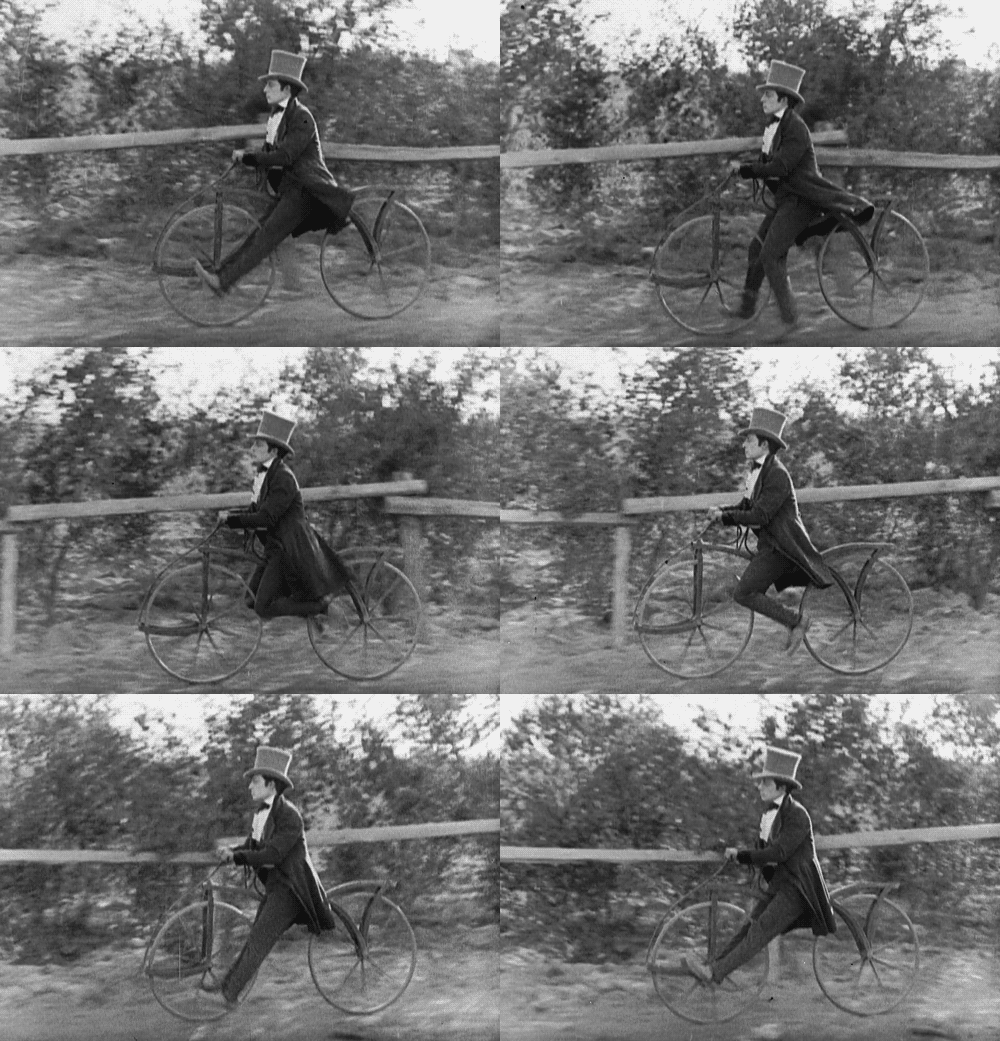
Cycling To Shoreham 1901
Whenever Tommy was excited or stressed, which to be honest was most days, he’d put the word ‘chuffing’ in front of everything. For instance, today was going to be a blooming chuffing day with loads of chuffing hills to cycle up and when we got to the ballyhoo top well we’d chuffing have a pick nick.
You see what I mean?
Tommy was a good egg, a decent sort who would lift a finger to help anyone, a talented tennis player, cyclist and a very good footballer. On the other side, he was a frightful drunk, which thank goodness had only been that once, he was extremely competitive – he would bet you a farthing on who would blink first and he was useless with money. Apart from that he was the kind of gent you would be proud to call a friend.
So come Saturday morning, Tommy and I would be on our chuffing bicycles, out of the chuffing city and heading for the chuffing countryside (I promise to limit the use of chuffing in future) and this Saturday was no exception.
Tommy knocked at my door at 5.30 (in the morning may I say – I didn’t even know there was a 5.30 in the morning, if truth be told) “Get up, you chuffing wastrel” was the morning cry of the Tommesara Smitheratist bird and it tended to waken everyone else up as well.
“Will you please tell that very stupid friend of yours that it is far too early in the morning for his buffoonery” said my rather grumpy father without opening his eyes (apparently it helped him get back to sleep quicker). Like Tommy, my father tended to hook in a word and then beat it to death with its overuse. ‘Buffoon’ and ‘buffoonery’ were both in the process of getting six shades of purple knocked out of them. Luckily he hadn’t heard Tommy’s current obsession or that would have resulted in me having to leave home and declaring myself an orphan.
“Apologies Holmes but we have the whole of the south-east to explore and time is chuffing moving on.”
Every since he’d read The Adventures of Sherlock Holmes, I had received that name. It was better just to smile and accept my fate because he might come up with something far, far worse. On our cycling trips Tommy wanted to be known as Moriarty because he said the name felt good on his tongue. I know what you’re thinking, Tommy wasn’t the most intelligent of my friends.
By six o’clock in the morning we were happily cycling over the Thames and heading down the Old Kent road where the world was waiting to entertain Holmes and Moriarty.
“First stop, chuffing breakers” said my pal.
For those that don’t speak Tommyese, that meant breakfast must be had with all haste.
Toast, crumpets and coffee were the order of the day at Mrs O’Reilly’s tea room in Lewisham, a bargain at one shilling. Mrs O’Reilly had long since departed this life and gone to the big tea room in the sky. The place was actually run by a man with the name of Derek.
“’Mrs O’Reilly’s’ sounds that bit more romantic” said a very tattooed Derek. “People knows what to expect, with that name, but Derek’s Cafe, well it just don’t sound right, do it?”
Both I and Tommy left the premises agreeing that Derek was correct in what he had said but that we should avoid the place in future as Derek seemed to be two seagulls short of an aviary.
Although it had been five months, Tommy still insisted that he wear a black band on his right arm as a mark of respect for the old Queen. I told him that this was a new and exciting time, that this was a new century , this was 1901, after all, and goodness knows what the next hundred years would bring.
Tommy felt that the new century could chuffing well wait until his mourning was chuffing done. I know I promised to keep the use of ‘chuffing’ to a minimum but it seems impossible when in the company of Tommy Smithers, I will try harder – I promise.
Just as we left Bromley, Tommy declared that the countryside had properly started and although I tried very hard to see it, I was at a loss to notice the difference. Still Tommy knows what he’s talking about or so he tells me.
After a mile or so I hinted that perhaps an ale might be the order of the day. Tommy stopped so fast that I almost ran into the back of him.
“I have a plan” he said (actually he said ‘a chuffing plan’ but I thought I would spare you that nonsense).
“And your plan is what, Tommy?” that was my contribution to the discussion.
“I know of a little village in the Darenth Valley where the ale is like nectar.” Tommy was tasting the ale in his mind’s eye.
“Why haven’t you told me of this place before?” I ask.
“Because my dear friend, it is not a place for the unwary.”
“Why is that Tommy?” I ask.
“Because my fine fellow, it is a hot bed of liberalism and creativity. People have really let things slide in this village. There are some women who are so close to looking like men, that one might wish them ‘a good morning sir’ without realising.”
“Well I never.” I declared.
“Worse still..” Tommy looks around before whispering “..there are men in this village who do not like the company of women. There I’ve said the chuffing thing. It’s too late but it’s out in the big world for all to know.”
“Don’t like the company of women?” I think I may have look perplexed.
“Really, you know what I mean, stop being a chuffing idiot. They don’t like women.”
So I had to have my say and I mentioned “I don’t know any men who don’t like women apart from Father who hasn’t spoken to Mother since she tried to fry the porridge. That must be eleven years ago, now.”
“Your mother tried to fry porridge?” says Tommy.
“She did, and Father said that any woman who was stupid enough to try to fry porridge shouldn’t expect any conversation to be thrown her way in future and that was that. He never said a bally word to her again. He said she was an imbecile, a harsh word I grant you, but I think that was his word of the week at that particular time.”
I expected Tommy to be impressed with this story but instead he said that I should stop talking chuffing rot and stop acting like an imbecile.
That is why, by the time we got to the little village, Tommy had dropped the word ‘chuffing’ in favour of the word ‘imbecile’. Why hadn’t I said that my father had called my mother ‘lovable’ or had given her money to shut her up? Maybe then Tommy would have done the same.
“Hey, ho, oft we go” shouted Tommy, adding “you imbecile.”
I do rather make things difficult for myself when I don’t bally mean to.
The village clock was striking one o’clock as we freewheeled our way down the hill into the centre of this dastardly liberal little village. I had to be honest with Tommy and tell him that I thought the people looked jolly normal.
“Nonsense, you imbecile” was his reply.
We parked up outside a delightful little public house called The Crown. The door was at an angle to the building and led into a small bar for gentlemen.
“Just in case this pub is over run by liberals let me do the talking” said reliable Tommy, “just to be on the safe side.”
Now to me, the person serving behind the bar was clearly a man but Tommy insisted on calling him ‘Mam’ then winking to me in a very obvious manner followed by him touching the side of his nose with his finger.
“I didn’t want to drink in the place anyway” said a rather surprised Tommy, “the establishment looked totally unsavoury. We are well shot of it.”At least the barman only asked me to leave whereas he caught Tommy by the collar and threw him out of the door.
Tommy said that he was right about the place all along, it was a den of liberal-minded imbeciles and he would be writing to his Member of Parliament just as soon as he returned from the country.
We tried to gain access at the next pub, the Two Brewers but apparently Tommy had been there before and was no longer welcome. I didn’t realise that you could use so many cursing words in one sentence but the manager of The Two Brewers must have broken a record.
“Another den of imbeciles?” I asked.
“Just so.”
That is why we came to be sitting outside the Kings Arms drinking two of the most wonderful glasses of ale. Apparently this was not a den of imbeciles and the prices were exceedingly fair.
Having slaked our thirst we mounted our trusted bicycles and headed towards the large town which sat at the top of the hill, above the village.
About one-third of the way up the hill, Tommy suggested that we dismount and push our bicycles up the rest of the way. Apparently it didn’t do the bicycles much good to be treated to a hill in the manner we were riding them. To be honest I thought maybe Tommy found the hill a little too steep but in fear of being called an imbecile, I refrained.
The climb was worth the effort and the view over the North Downs was spell binding.
Why people steal bicycles is beyond me, and two of them at the same time. You have to ask yourself – was the thief a member of some circus troupe? However the dastardly deed was done and it meant that cycling back to London was now out of the question. A train was called for and a train it would be.
Tommy suggested that we travel back by First Class and that I should foot the bill seeing as I was the last one to see the bally bicycles. I actually think the last time I saw them, I said “Tommy, do you think the bicycles are safe by that public house? ” Whereupon Tommy called me an imbecile and told me in no uncertain terms that if I was worried about people stealing our property, well that sort of thing just didn’t happen in the countryside. Then he said “Grow up man.” The next time I looked the bicycles were gone.
In the railway carriage, on the way back to the city, a rather plump man and his rather plump wife were playing cards. The husband seemed to have won a round as he let out the most frightening cry of ‘Ballyhoo’.
I could see the glimmer in Tommy’s eyes as he tried the word ‘Ballyhoo’ out on his tongue.
The word was not found wanting.
Unfortunately.
bobby stevenson 1901 and 2016
Friday, 6 November 2015
The Titanic in New York City - The Three Stories
Wednesday April 17th, 1912 Pier 60. NY,NY.
Annie's Story
She was born with the name, Annie Constantine and from the age of nine, she had worked tirelessly as a kitchen maid in a large house on the south coast of England.
Annie could not settle for a life in service – she gracefully rose at 4am and fell into bed at midnight, but she told herself this was not going to be forever. She had bigger ideas, she knew was going to go to the new world one day and nothing was going to stop her.
By the time she was eighteen, she had two proposals of marriage (both rejected), and two lovers who came from the overlords who lived in the floors above.
Annie had a photo of New York City pinned to the wall of the little room she shared with two other girls.
She had heard Lord Carnforth, her employer, talk about a great ship that both he and his wife were sailing aboard to the United States: The Titanic. When that name tickled her ears she knew it was destiny, she had waited for this very moment. Annie had saved her meagre wages and at last she could afford a third class ticket - one way, of course. She got one of the footmen, whom she trusted, to purchase a ticket for her while he was on a visit to his family in Southampton.
Apart from the footman, no one else knew of her plan. So on the morning before the Titanic was due to depart for New York, she packed a small valise and headed down the back path, never to return.
For her, the voyage, although being celebrated around the world, was one of monotony; the truth was she couldn’t wait to get started in her new country, to begin her new life.
She had been in contact with an old friend, Sarah, who had met a ‘Yankee’ while she was appearing on the music hall in London’s Haymarket. Sarah had married her gentleman caller and they had both moved into a small apartment in Harlem.
Sarah was there to meet and greet her friend, and all the way on the trolley north, Sarah talked non-stop about her new life in a great city. Annie didn’t hear most of it, as she could not help herself but constantly look at the wondrous views from the window of the trolley; it was 1912 and Annie Constantine was at the centre of the new world.
The plan was for Annie to live with Sarah until she could stand on her own two feet. However this plan fell apart. After three days Annie was working harder than ever, cooking for Sara and her ‘Yankee’. Cleaning, and fetching the groceries, she was more exhausted than she had been at the big house.
So once again, Annie got up early one morning, took several dollars from her Sarah’s saving’s box (Annie reckoned she had earned it, but swore to replace it one day) and took a train west.
Within in a month, she found herself at the end of the line, and decided that she would settle in California and see how things went. In the sun and far from the drudgery of a maid’s work, she blossomed into a beauty. This didn’t go unnoticed, especially with one, Max Sennett who had opened up the Keystone Movie Company.
Annie had to be honest, the first couple of one-reelers she made as the heroine were terrible, but Max had faith in her and it paid off. By the following year, Annie was the studio’s number one star and had started to work with a young English actor by the name of Charlie Chaplin.
Annie couldn’t see Charlie’s little tramp character having any sort of appeal and subsequently, Charlie was dismissed and returned to England to work in a factory – he never made another movie.
By 1920, Annie (now named Ann Silver) was the biggest light in the firmament and was commanding several thousand dollars a movie. She married for the fourth time in 1925, having given birth to two sons and two daughters by her previous three husbands.
In 1929, it was decided that Ann’s movie, ‘The Little Honey Girl’ would be the first talking picture – it had been a choice between her and Al Jolson’s ’The Jazz Singer’ but Ann’s looks and popularity won the day. Ann’s voice seduced the crowds once again, and in even more numbers.
When she married for a sixth time, she built a little house on the island of Catalina, a few miles off the California coast. It was while she was sailing there one afternoon, that her ship (which she had named The Titanic after the one which had brought her to a new life) sank with all hands. Her body was never recovered.
Adel and Dirk's Story
That Wednesday morning, the sun shone, and a gentle breeze blew in from the sea. As far as Adel was concerned, she had everything in life she wanted. She lived in Brighton Beach at the bottom end of Brooklyn, and she had a job painting decorations on the rides at Coney Island.
She had been in New York City for almost a year. A year of struggling and making a life for herself in a new country. It had been lonely at the start, but the work had allowed her to paint and express herself. She had two friends, but as she worked most of the time, it really was difficult to meet people.
On that sunny morning, her cousin Dirk was arriving from Europe on the biggest ship in the world; the Titanic. Both their families came from Stuttgart, and as a girl Adel had been close to her older cousin. Now that she felt herself more American, she was pleased that another of her tribe would experience the exciting land that was the United States.
Dirk had qualified as a doctor, and in appreciation of this achievement, his family had saved money to send him second class on the Titanic.
She knew that the ship was due within the hour and that she could watch it pass from her little apartment on the Avenue, but instead she took an elevated transit from Coney Island into Manhattan. She had heard that there was going to be a large crowd to welcome the greatest ship to the greatest city in the world.
She took a trolley across to the west side, to Pier 60 on the Hudson. There were many people trying to get to the pier, and the crowd stretched all the way to the Battery. Adel wanted to welcome her cousin personally when he stepped from the ship.
She bought a hotdog and a lemonade as she waited, listening to the bands, some of which had come up from Coney Island. She had been granted the holiday by her boss, as long as she worked the following Saturday.
After what seemed a lifetime, she saw the funnels, and then the grandeur of what was the largest ship she had ever seen. It was beautiful, so beautiful that it took her breath away. She wiped back the tears and waved with the rest of the New Yorkers to greet the Titanic.
It was several hours before she was able to walk up and hug her cousin. He had to be processed through Ellis Island, as she had been, before he was allowed to set foot on Manhattan.
She cried again, it was wonderful to see one of her family again and to be able to talk in her mother tongue. Dirk hadn’t brought much with him and so they decided to walk up Fifth Avenue and enjoy the sights of the city.
They got back to her apartment, in Brighton Beach in the early evening. The sun was already sinking on this happy April day and she had baked treats that she would have made back home. She wanted make Dirk feel really welcome.
He was excited by his new country and full of hope, he told Adel. Perhaps he could be a great doctor in America, or perhaps even the President himself. Adel told him that he would have to have been born in the United States but she loved his dreams.
Then he told stories of the crossing of the Atlantic on the Titanic, how they had been troubled by icebergs but the captain had slowed the ship a little and all was well.
Tomorrow she had to go back to work at Coney Island but she would introduce Dirk to her boss, who might be able to help in getting him work. Dirk thanked his cousin and took his little bag into the kitchen where she had made him up a bed. Adel wished him goodnight and hoped that God would be kind to him in the new land.
As Dirk settled down, he took out the code book which he had been supplied, and went over once again the instructions he had been given. Not if, but when, there was a war in Europe and the mighty armies of the Fatherland moved into France and Britain, the Kaiser wanted assurance that the US would be in no position to join the war.
Dirk had one activity and one activity only, and that was to assassinate the President of the United States when the signal came from the Fatherland.Dirk slept well that first night in his new country and dreamed of the bright new world that was to come.
She was born with the name, Annie Constantine and from the age of nine, she had worked tirelessly as a kitchen maid in a large house on the south coast of England.
Annie could not settle for a life in service – she gracefully rose at 4am and fell into bed at midnight, but she told herself this was not going to be forever. She had bigger ideas, she knew was going to go to the new world one day and nothing was going to stop her.
By the time she was eighteen, she had two proposals of marriage (both rejected), and two lovers who came from the overlords who lived in the floors above.
Annie had a photo of New York City pinned to the wall of the little room she shared with two other girls.
She had heard Lord Carnforth, her employer, talk about a great ship that both he and his wife were sailing aboard to the United States: The Titanic. When that name tickled her ears she knew it was destiny, she had waited for this very moment. Annie had saved her meagre wages and at last she could afford a third class ticket - one way, of course. She got one of the footmen, whom she trusted, to purchase a ticket for her while he was on a visit to his family in Southampton.
Apart from the footman, no one else knew of her plan. So on the morning before the Titanic was due to depart for New York, she packed a small valise and headed down the back path, never to return.
For her, the voyage, although being celebrated around the world, was one of monotony; the truth was she couldn’t wait to get started in her new country, to begin her new life.
She had been in contact with an old friend, Sarah, who had met a ‘Yankee’ while she was appearing on the music hall in London’s Haymarket. Sarah had married her gentleman caller and they had both moved into a small apartment in Harlem.
Sarah was there to meet and greet her friend, and all the way on the trolley north, Sarah talked non-stop about her new life in a great city. Annie didn’t hear most of it, as she could not help herself but constantly look at the wondrous views from the window of the trolley; it was 1912 and Annie Constantine was at the centre of the new world.
The plan was for Annie to live with Sarah until she could stand on her own two feet. However this plan fell apart. After three days Annie was working harder than ever, cooking for Sara and her ‘Yankee’. Cleaning, and fetching the groceries, she was more exhausted than she had been at the big house.
So once again, Annie got up early one morning, took several dollars from her Sarah’s saving’s box (Annie reckoned she had earned it, but swore to replace it one day) and took a train west.
Within in a month, she found herself at the end of the line, and decided that she would settle in California and see how things went. In the sun and far from the drudgery of a maid’s work, she blossomed into a beauty. This didn’t go unnoticed, especially with one, Max Sennett who had opened up the Keystone Movie Company.
Annie had to be honest, the first couple of one-reelers she made as the heroine were terrible, but Max had faith in her and it paid off. By the following year, Annie was the studio’s number one star and had started to work with a young English actor by the name of Charlie Chaplin.
Annie couldn’t see Charlie’s little tramp character having any sort of appeal and subsequently, Charlie was dismissed and returned to England to work in a factory – he never made another movie.
By 1920, Annie (now named Ann Silver) was the biggest light in the firmament and was commanding several thousand dollars a movie. She married for the fourth time in 1925, having given birth to two sons and two daughters by her previous three husbands.
In 1929, it was decided that Ann’s movie, ‘The Little Honey Girl’ would be the first talking picture – it had been a choice between her and Al Jolson’s ’The Jazz Singer’ but Ann’s looks and popularity won the day. Ann’s voice seduced the crowds once again, and in even more numbers.
When she married for a sixth time, she built a little house on the island of Catalina, a few miles off the California coast. It was while she was sailing there one afternoon, that her ship (which she had named The Titanic after the one which had brought her to a new life) sank with all hands. Her body was never recovered.
Adel and Dirk's Story
That Wednesday morning, the sun shone, and a gentle breeze blew in from the sea. As far as Adel was concerned, she had everything in life she wanted. She lived in Brighton Beach at the bottom end of Brooklyn, and she had a job painting decorations on the rides at Coney Island.
She had been in New York City for almost a year. A year of struggling and making a life for herself in a new country. It had been lonely at the start, but the work had allowed her to paint and express herself. She had two friends, but as she worked most of the time, it really was difficult to meet people.
On that sunny morning, her cousin Dirk was arriving from Europe on the biggest ship in the world; the Titanic. Both their families came from Stuttgart, and as a girl Adel had been close to her older cousin. Now that she felt herself more American, she was pleased that another of her tribe would experience the exciting land that was the United States.
Dirk had qualified as a doctor, and in appreciation of this achievement, his family had saved money to send him second class on the Titanic.
She knew that the ship was due within the hour and that she could watch it pass from her little apartment on the Avenue, but instead she took an elevated transit from Coney Island into Manhattan. She had heard that there was going to be a large crowd to welcome the greatest ship to the greatest city in the world.
She took a trolley across to the west side, to Pier 60 on the Hudson. There were many people trying to get to the pier, and the crowd stretched all the way to the Battery. Adel wanted to welcome her cousin personally when he stepped from the ship.
She bought a hotdog and a lemonade as she waited, listening to the bands, some of which had come up from Coney Island. She had been granted the holiday by her boss, as long as she worked the following Saturday.
After what seemed a lifetime, she saw the funnels, and then the grandeur of what was the largest ship she had ever seen. It was beautiful, so beautiful that it took her breath away. She wiped back the tears and waved with the rest of the New Yorkers to greet the Titanic.
It was several hours before she was able to walk up and hug her cousin. He had to be processed through Ellis Island, as she had been, before he was allowed to set foot on Manhattan.
She cried again, it was wonderful to see one of her family again and to be able to talk in her mother tongue. Dirk hadn’t brought much with him and so they decided to walk up Fifth Avenue and enjoy the sights of the city.
They got back to her apartment, in Brighton Beach in the early evening. The sun was already sinking on this happy April day and she had baked treats that she would have made back home. She wanted make Dirk feel really welcome.
He was excited by his new country and full of hope, he told Adel. Perhaps he could be a great doctor in America, or perhaps even the President himself. Adel told him that he would have to have been born in the United States but she loved his dreams.
Then he told stories of the crossing of the Atlantic on the Titanic, how they had been troubled by icebergs but the captain had slowed the ship a little and all was well.
Tomorrow she had to go back to work at Coney Island but she would introduce Dirk to her boss, who might be able to help in getting him work. Dirk thanked his cousin and took his little bag into the kitchen where she had made him up a bed. Adel wished him goodnight and hoped that God would be kind to him in the new land.
As Dirk settled down, he took out the code book which he had been supplied, and went over once again the instructions he had been given. Not if, but when, there was a war in Europe and the mighty armies of the Fatherland moved into France and Britain, the Kaiser wanted assurance that the US would be in no position to join the war.
Dirk had one activity and one activity only, and that was to assassinate the President of the United States when the signal came from the Fatherland.Dirk slept well that first night in his new country and dreamed of the bright new world that was to come.
Julia's Story
Her name was simply, Julia Edinburgh – not doctor and not professor; she was a woman after all in 1912. She was probably the cleverest of all people working on the causes and treatment of cancers. Her husband was a doctor, but he had grown to admire and love his wife and her ability to see patterns and signs in medical information that most people overlooked.
She felt that after several years of investigation and begging money from family and friends, she was now able to say categorically what had been the initial cause of specific cancers. Even more exciting was the certainty she felt, that she had come up with a process to halt the cell division – in other words, a cure for some cancers.
What concerned her most was there was to be a symposium of cancer specialists in Washington DC, on Monday the 21st of April – all of them men. She also knew that the main speaker was going to present his theory of cancer as a germ that is spread throughout the body. There was a train of thought, at the time, that cancer was a small protozoa – a small creature which transported itself from cell to cell.
She knew this was so far from the truth and that it might put cancer research back many years. It was important that she got to this meeting and contradicted their thoughts by presenting what she considered a cure for the disease.
Her husband had always been a fan of ships since he was a little boy, and it was at his suggestion that Doctor Samuel Edinburgh and his wife, Julia should take a second class compartment aboard the Titanic on her maiden voyage, bound for New York City. The Edinburghs would then take the train south to Washington, in time for the meeting.
They boarded at Southampton and took pleasure in their small but comfortable cabin. Doctor Edinburgh found that his love of ships had him exploring all areas of the Titanic. This allowed his wife to spend her time writing and re-writing her presentation on the causes and cures for cancer.
It was on the evening of Sunday the 14th of April, that the doctor found himself taking a stroll on the top deck. He always found that such a walk and taking the airs helped him sleep better. It also allowed his darling wife a little extra time to consider her thoughts.
The doctor couldn’t believe it at first - but he ran towards the bow, it appeared that there was an iceberg off the starboard side of the great RMS Titanic. He ran and found a steward, whom he quickly impressed upon, that it was important that the captain should be informed immediately.
This is what actually occurred, the captain was able to make manoeuvres, which allowed the Titanic to swerve to the port side of the berg. The Captain felt that he had been lucky this time and slowed the ship’s speed for the final part of the voyage into New York.
By the time the doctor got back to his cabin, his wife was asleep. He failed to tell her in the morning of his escapade the previous evening.
Julia did, in fact, make the symposium on cancer in Washington D.C. and it was her brave work which brought about the start of cures being found for several types of cancer.
She died in 1967, in Long Island with her grandchildren by her side.
Her name was simply, Julia Edinburgh – not doctor and not professor; she was a woman after all in 1912. She was probably the cleverest of all people working on the causes and treatment of cancers. Her husband was a doctor, but he had grown to admire and love his wife and her ability to see patterns and signs in medical information that most people overlooked.
She felt that after several years of investigation and begging money from family and friends, she was now able to say categorically what had been the initial cause of specific cancers. Even more exciting was the certainty she felt, that she had come up with a process to halt the cell division – in other words, a cure for some cancers.
What concerned her most was there was to be a symposium of cancer specialists in Washington DC, on Monday the 21st of April – all of them men. She also knew that the main speaker was going to present his theory of cancer as a germ that is spread throughout the body. There was a train of thought, at the time, that cancer was a small protozoa – a small creature which transported itself from cell to cell.
She knew this was so far from the truth and that it might put cancer research back many years. It was important that she got to this meeting and contradicted their thoughts by presenting what she considered a cure for the disease.
Her husband had always been a fan of ships since he was a little boy, and it was at his suggestion that Doctor Samuel Edinburgh and his wife, Julia should take a second class compartment aboard the Titanic on her maiden voyage, bound for New York City. The Edinburghs would then take the train south to Washington, in time for the meeting.
They boarded at Southampton and took pleasure in their small but comfortable cabin. Doctor Edinburgh found that his love of ships had him exploring all areas of the Titanic. This allowed his wife to spend her time writing and re-writing her presentation on the causes and cures for cancer.
It was on the evening of Sunday the 14th of April, that the doctor found himself taking a stroll on the top deck. He always found that such a walk and taking the airs helped him sleep better. It also allowed his darling wife a little extra time to consider her thoughts.
The doctor couldn’t believe it at first - but he ran towards the bow, it appeared that there was an iceberg off the starboard side of the great RMS Titanic. He ran and found a steward, whom he quickly impressed upon, that it was important that the captain should be informed immediately.
This is what actually occurred, the captain was able to make manoeuvres, which allowed the Titanic to swerve to the port side of the berg. The Captain felt that he had been lucky this time and slowed the ship’s speed for the final part of the voyage into New York.
By the time the doctor got back to his cabin, his wife was asleep. He failed to tell her in the morning of his escapade the previous evening.
Julia did, in fact, make the symposium on cancer in Washington D.C. and it was her brave work which brought about the start of cures being found for several types of cancer.
She died in 1967, in Long Island with her grandchildren by her side.
bobby stevenson 2015
http://www.randomactsstories.blogspot.com/
Subscribe to:
Posts (Atom)
A Perfect Place To Be
Another new morning in Deal. I haven’t checked the telephone, and I sure as hell haven’t switched on the TV with all that news. So I lie t...
-
Some things remain with you forever. When I was ten years old, my father took me on a trip in an old battered car and caravan, and a...
-
For John Lennon - died 8th December, 1980 New York City, December 1963 I remember fighting a rather lonely wind as I cr...
-
If Alexandra McMillan had been born in any era other than her own, she would have most certainly been burned as a witch. Luckily for her...